Animation & Rigging
Get Moving
Whether it’s simple keyframing or complex walk-cycles, Blender allows artists to turn their still characters into impressive animations.
Blender's animation feature set offers:
- Character animation pose editor
- Non Linear Animation (NLA) for independent movements
- Forward/inverse kinematics for fast poses
- Sound synchronization
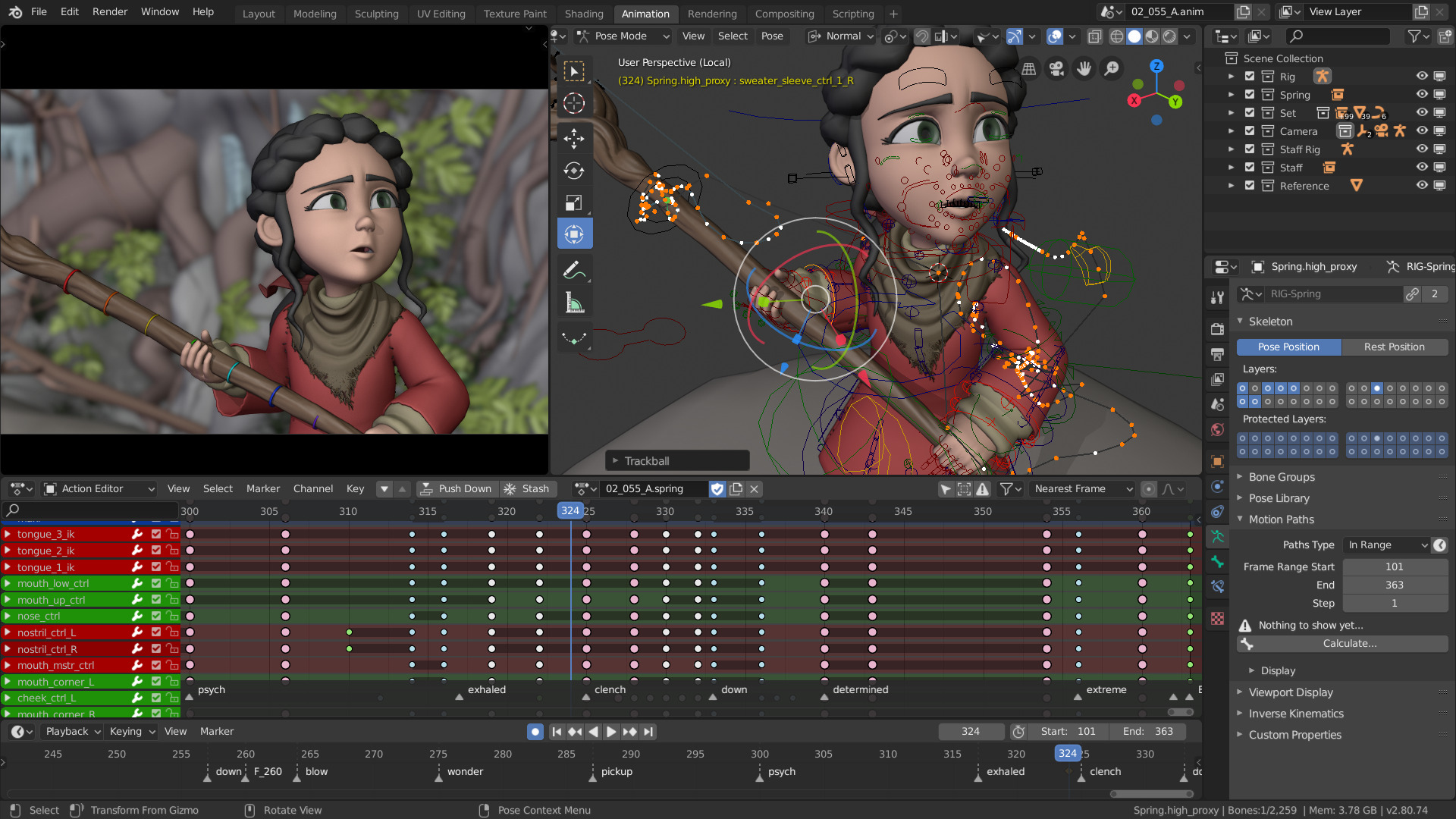
Transforming a model into a posable character has never been easier!
Blender offers an impressive set of rigging tools including:
- Envelope, skeleton and automatic skinning
- Easy weight painting
- Mirror functionality
- Bone layers and colored groups for organization
- B-spline interpolated bones
Constraints are a way to control an object’s properties (e.g. its location, rotation, scale), using either plain static values (like the “limit” ones), or another object, called “target” (like e.g. the “copy” ones).
- You can control an object’s animation through the targets used by its constraints
(this is a form of indirect animation). Indeed,
these targets can then control the constraint’s owner’s properties, and hence,
animating the targets will indirectly animate the owner. - You can animate constraints’ settings. e.g. the Influence or
when using an armature’s bone as target,
animate where along this bone (between root and tip) lays the real target point.
Drivers are a way to control values of properties by means of a function, mathematical expression or small script.
Effectively, drivers are composed by:
- A driver configuration that specifies input values from properties and
combines them with a mathematical expression or Python script. - An animation F-Curve
that maps the output of the driver configuration to the value to apply
to the driven property.
Shape keys are used to deform objects into new shapes for animation. In other terminology, shape keys may be called “morph targets” or “blend shapes”.
The most popular use cases for shape keys are in character facial animation and in tweaking and refining a skeletal rig. They are particularly useful for modeling organic soft parts and muscles where there is a need for more control over the resulting shape than what can be achieved with combination of rotation and scale.
The Motion Paths tool allows you to visualize the motion of points as paths over a series of frames. These points can be object origins and bone joints.

No comments:
Post a Comment